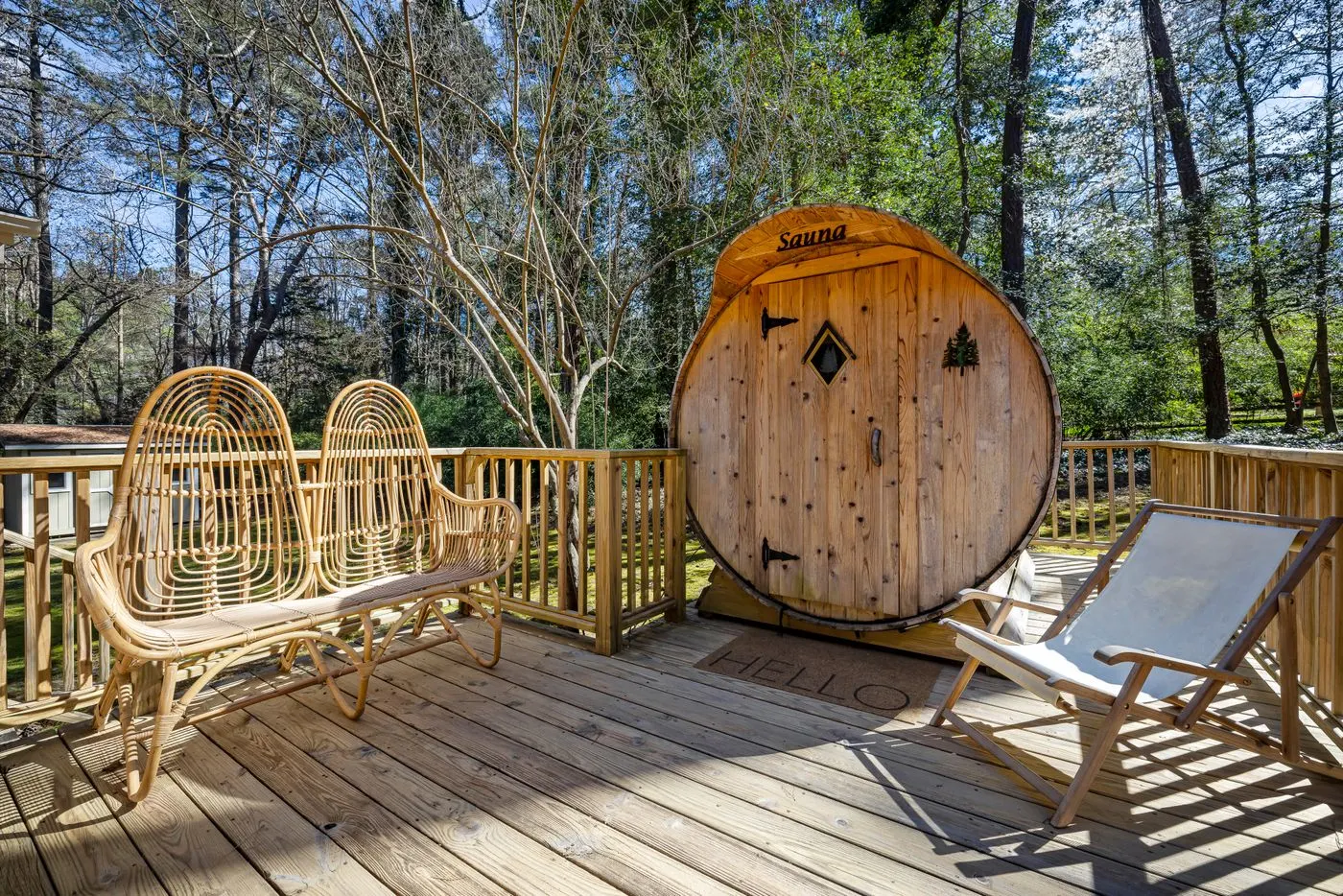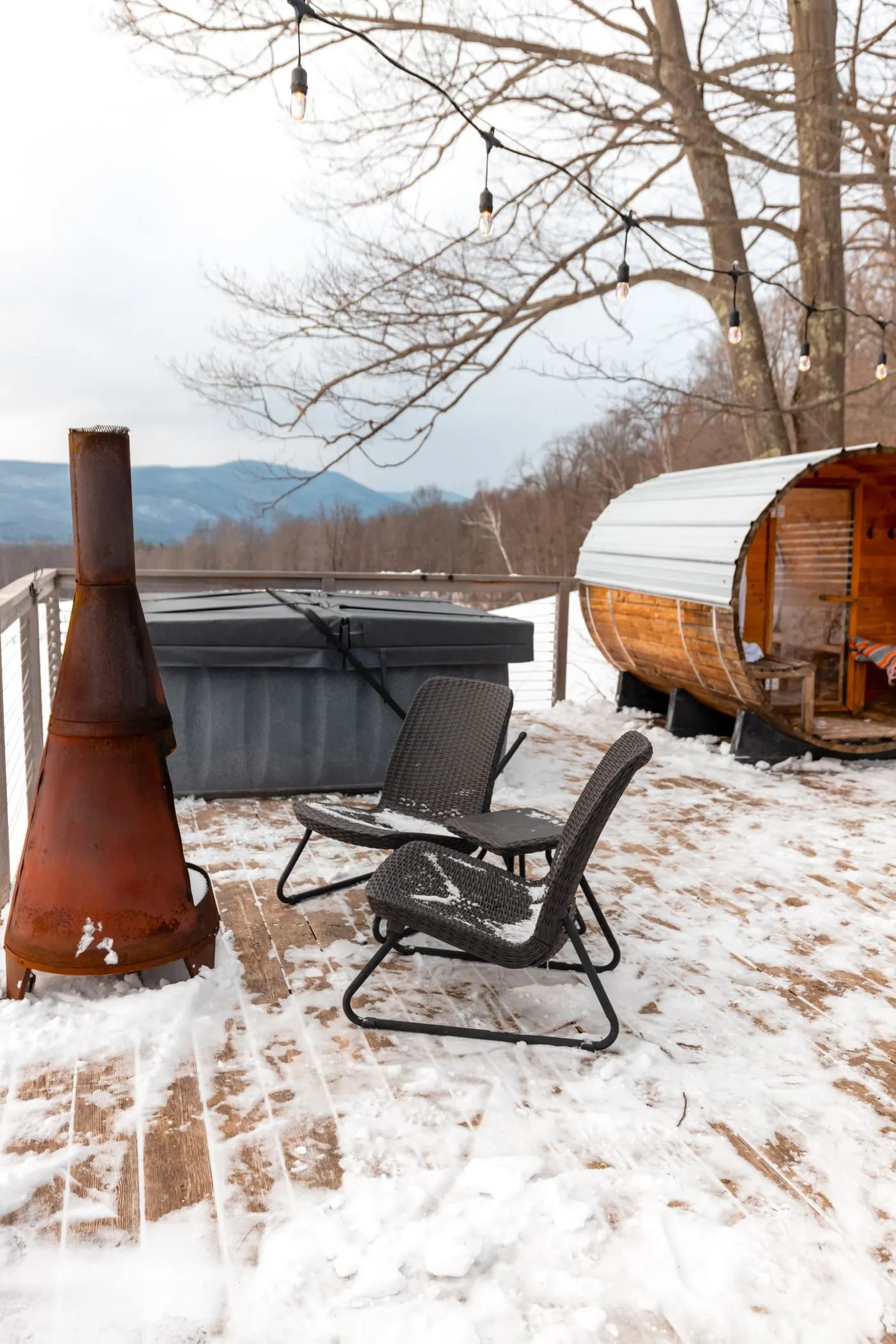
You can build an outdoor sauna on a deck, but only if the deck is structurally rated for the concentrated weight of the sauna, stove, stones and bathers, and its own footings resist frost heave. A deck also raises real fire-protection questions for the heater — a wood stove on a combustible deck needs proper non-combustible protection and clearances. Weigh the sauna's load, the deck's frost-safe footings, moisture and fire before assuming a deck can carry a sauna.
A deck can be a beautiful place for a sauna — raised, dry underfoot, connected to the house or overlooking the yard. But “can I just put the sauna on my deck?” deserves a careful answer, because a deck is a foundation, and it has to carry the load, resist frost heave, handle moisture and, if there’s a wood stove, protect against fire. This guide covers what a deck-mounted sauna really needs.
Can a deck carry a sauna?
Sometimes — but not by default. A sauna concentrates significant weight: the structure itself, plus the heater, a bank of stones, benches, and several bathers. Many decks are built for patio furniture and people, not for a small, heavy building. So the first question is structural: are the deck’s joists, beams and footings rated for the sauna’s load?
If there’s any doubt — and there often should be — check the deck against the load and reinforce it, or consult a builder, before proceeding. Overloading a deck is a genuine safety risk, not a cosmetic one.
Frost-safe footings
A deck carrying a sauna in a Canadian climate needs footings that resist frost heave — typically reaching below the frost line, like piers or ground screws. A deck on shallow footings that heaves in winter will tilt the sauna along with it. Treat the deck’s footings with the same frost care you’d give any sauna foundation; a level sauna needs a level, frost-stable deck.
The heater and fire protection
This is the point people miss. A wood-burning heater on a combustible wooden deck raises real fire-protection questions:
- Non-combustible floor protection beneath and around the stove.
- Correct clearances to the deck, walls and combustibles.
- A compliant chimney and penetration.
All to the manufacturer’s manual and your local fire code — never guessed. Don’t set a wood stove on bare decking. Where proper fire protection can’t be achieved on the deck, reconsider the location or choose an electric heater (which still needs its clearances and a licensed electrical connection, but no chimney or combustion). See heater installation and our safety guidance.
Moisture and drainage
A sauna produces steam, and any cold-plunge or shower adds splash. On a deck, that water must drain and dry rather than sit on or soak into the decking. Plan for:
- Drainage so water runs off and away.
- Drying the sauna after use.
- Moisture-tolerant decking and structure.
Trapped water rots decks over time, so moisture management protects both the sauna and the deck.
Pros and cons of a deck foundation
Advantages
- Raised, dry, finished platform
- Connects the sauna to the house or view
- Can integrate with an existing outdoor space
- Ventilated space beneath
Limitations
- Must be structurally rated for the load
- Footings must resist frost heave
- Fire protection is critical for a wood stove
- Moisture must drain, not soak the deck
- Often needs reinforcement or purpose design
When a deck makes sense
A deck foundation works well when:
- The deck is purpose-built or reinforced for the sauna’s load.
- Its footings are frost-safe.
- The heater’s fire protection is properly handled (or it’s electric).
- Moisture is planned to drain and dry.
If those boxes are ticked, a deck is a lovely, practical base. If not, a dedicated gravel pad, piers or ground screws beside the deck is often simpler and safer than forcing a sauna onto an unsuitable deck.
Common mistakes
- Assuming an ordinary deck can carry a sauna without checking the structure.
- A wood stove on bare decking with no fire protection.
- Shallow deck footings that heave in winter.
- Letting steam and splash soak the deck.
- Retrofitting a finished deck instead of planning the load and protection up front.
Next steps
If you want a sauna on a deck, plan the structure, frost-safe footings, fire protection and drainage together, and reinforce or design the deck for the load — with a builder’s input where needed. For the heater side, see installation and safety; for the alternatives, start with best foundation for an outdoor sauna.
Frequently asked questions
Can you put a sauna on a deck?
Yes, if the deck is designed and rated for the load and built on frost-safe footings, and the heater's fire protection is properly handled. A sauna plus stove, stones and bathers is a concentrated weight, and a wood stove on a combustible deck needs non-combustible protection and clearances. An ordinary deck is often not built for this without reinforcement.
Will a deck hold the weight of a sauna?
Only if it was designed to. A sauna concentrates significant weight — the structure, heater, stones, benches and people — and many decks are not built for that. Check the deck's structure, joists, beams and footings against the load, and reinforce it or consult a builder if there is any doubt. Overloading a deck is a safety risk.
Is it safe to put a wood-burning sauna on a wooden deck?
It requires careful fire protection. A wood-burning heater on a combustible deck needs non-combustible floor protection beneath and around it, correct clearances and a compliant chimney, all to the manufacturer's manual and local fire code. Don't place a wood stove on bare decking. Where the fire protection can't be done properly, reconsider the location or use electric.
Do deck footings need to go below the frost line?
For a deck carrying a sauna in a cold climate, the footings should resist frost heave — typically by reaching below the frost line, like piers or ground screws — so the deck and sauna stay level. A deck on shallow footings can heave in winter and tilt the sauna. Treat the deck's footings with the same frost care as any sauna foundation.
Does a sauna on a deck have moisture problems?
It can, so plan for water. Steam and any splash need to drain and dry rather than sitting on or soaking the decking, and the deck boards and structure must tolerate the moisture. Good drainage, drying the sauna after use, and moisture-tolerant materials keep a deck-mounted sauna sound. Trapped water rots decks over time.
Should I build the deck or the sauna first?
Plan them together. If the deck must carry a sauna, its structure, footings and fire protection have to be designed for that from the start — reinforcing or fire-protecting a finished deck afterward is harder. Decide the sauna's position and weight and the heater type before building or choosing the deck.