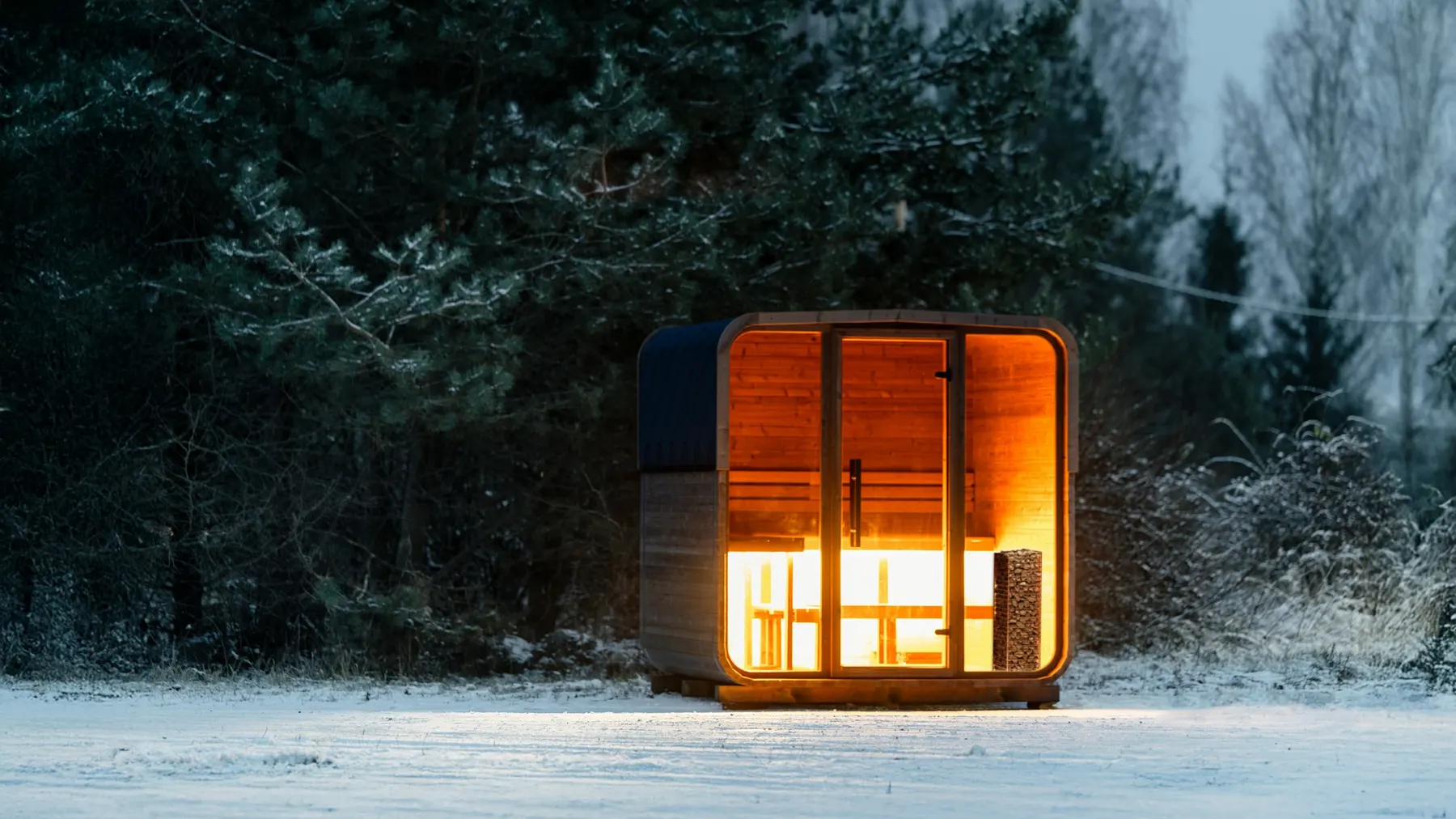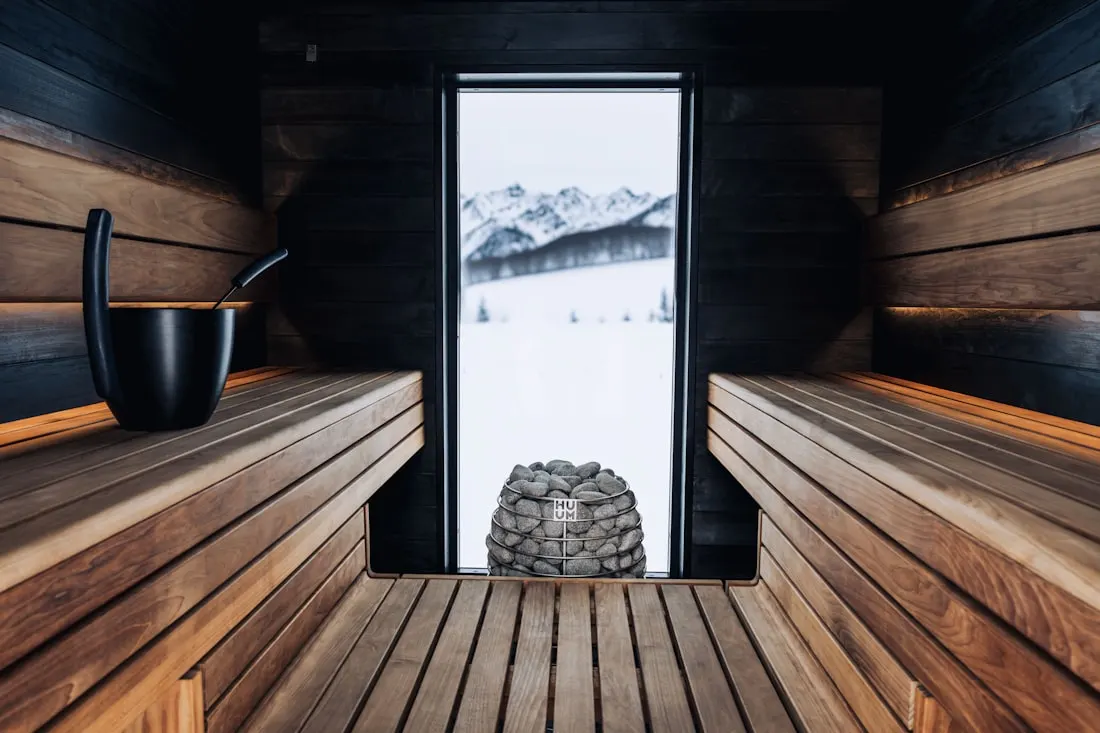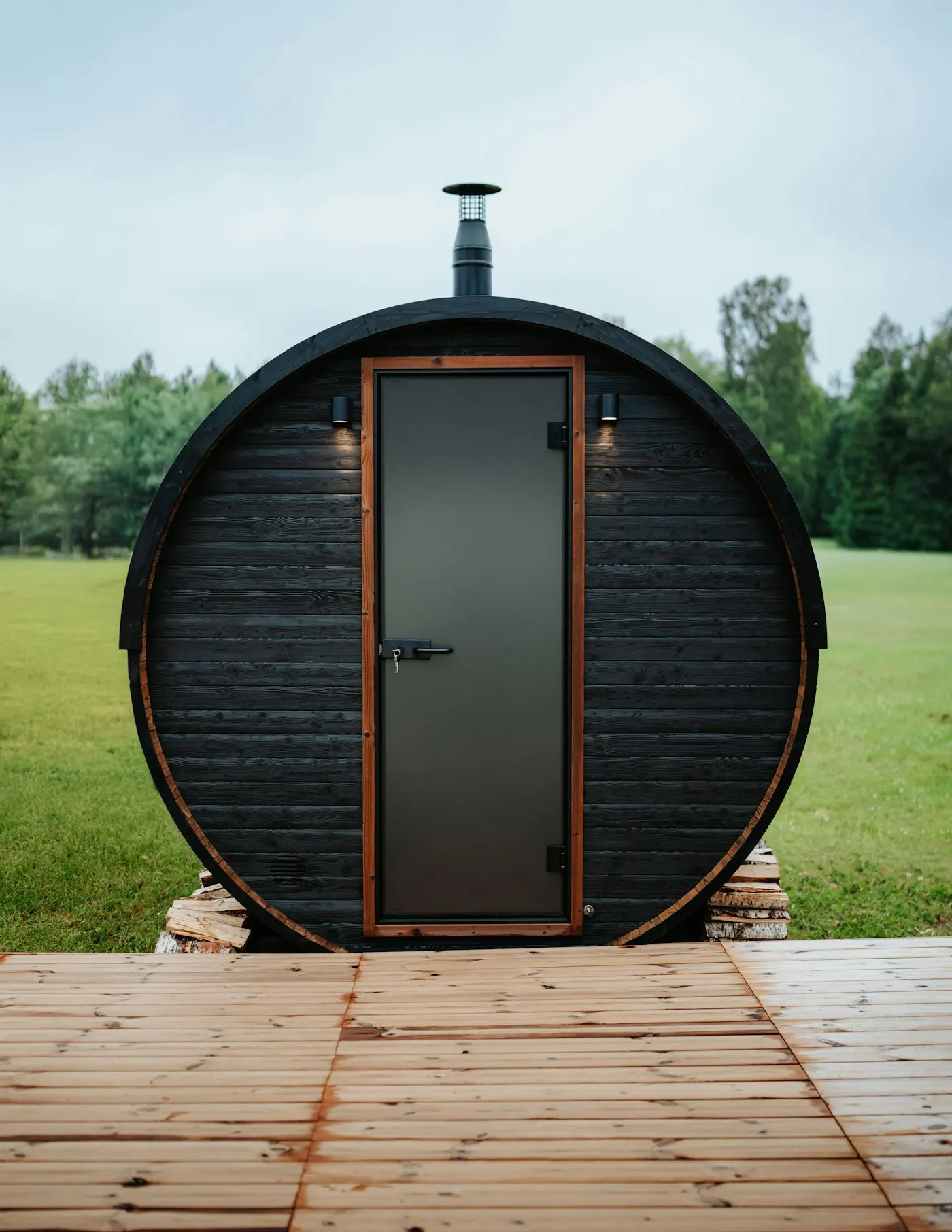
A barrel sauna is a cylindrical outdoor sauna built from thick, tongue-and-groove staves bound by steel bands. In a Canadian winter it warms up quickly and looks the part, but the round wall is hard to insulate, so it loses heat faster and is more prone to condensation than a framed cabin sauna. It's a strong choice when fast heat-up, lower cost and a compact form matter more than maximum efficiency.
Barrel saunas are the format most people picture first — and for good reason. They arrive as kits, assemble in a weekend, and the curved ceiling puts warm air right where you sit. But the same shape that makes them charming also sets real limits in a cold climate. This guide walks through how a barrel is built, how it behaves at −20 °C, and the decisions that separate a barrel that lasts from one that goes damp and draughty.
What a barrel sauna is
A barrel sauna is an outdoor sauna shaped like a horizontal cylinder. The walls, floor and ceiling are formed from the same thick staves — usually western or eastern red cedar, spruce or thermally treated wood — pulled tight by two or more steel tension bands. Circular end walls close the tube, one of them carrying the door and often a window.
Sizes typically run from about 1.8 m (6 ft) long for a two-person model up to 3 m (10 ft) or more with a built-in changing porch. Because the structure is self-supporting, a barrel needs no internal framing — which is exactly why insulating it is awkward, as we’ll see.
How a barrel sauna is built
Construction is deceptively simple, and the quality of a few details decides how it holds up outdoors:
- Staves: thick, kiln-dried, tongue-and-groove boards. Thicker staves store more heat and resist warping.
- Bands: galvanized or stainless steel bands that must be re-tensioned as the wood settles, especially in the first season.
- Cradles: shaped supports that hold the barrel off the ground and carry the load to the foundation.
- End walls: the door wall and back wall, where most air leakage and heat loss occur.
- Roof cover (optional): asphalt shingle, metal or a membrane over the top staves to shed water and slow weathering.
Site note
A barrel is light, but its cradles concentrate the load at a few points. It still needs a level, well-drained base that resists frost heave — see our foundations guide before you order a kit.
Round-wall heat circulation
The barrel’s best trick is convection. As the heater warms the air, it rises along the curved ceiling and rolls back down the far wall, circulating without the cold corners a boxy room can trap. That’s why a barrel feels like it heats fast: the shape moves warm air efficiently over a small volume.
The catch is that the same small, curved envelope has a lot of exposed surface relative to its interior, and it’s mostly single-layer wood. Warm air circulates well — but heat also escapes through that wood continuously, which is where winter performance and running cost come in.
Insulation limitations
This is the defining trade-off of the format. A framed cabin sauna has a stud cavity you can fill with mineral wool, then seal with a foil vapour barrier. A barrel usually has no cavity — the staves are the wall. Your options are all compromises:
- Thicker staves: more thermal mass and marginally better retention, at higher cost and weight.
- Insulated cradle or skirt: reduces loss through the base and blocks wind under the barrel.
- Second inner shell: some premium builds add an insulated liner, moving them closer to cabin performance — and cabin prices.
- Roof or blanket cover: an insulated top reduces the largest heat-loss surface.
None of these turn a barrel into a fully insulated building. Set expectations accordingly: a barrel trades some winter efficiency for simplicity and cost.
Canadian winter performance
Used sensibly, barrel saunas run all winter across Canada — plenty of them steam happily through Prairie and Shield cold snaps. The realities to plan for:
| Factor | Barrel sauna in winter | What helps |
|---|---|---|
| Warm-up time | Slower than in summer; often 45–75 min below freezing | Correctly sized heater; wind shelter |
| Heat retention | Loses heat faster than a cabin sauna | Roof cover; insulated skirt; draught-proof door |
| Wind exposure | Round wall catches wind; under-barrel draughts | Sheltered siting; skirting the cradles |
| Condensation | Higher risk on cold interior surfaces | Ventilation + drying after use |
Two levers matter most in the cold: heater sizing and siting. An undersized heater that’s fine in July will struggle in January; many owners size up, or choose a heater rated for a larger volume than the interior alone suggests. Placing the barrel out of the prevailing wind, with its door away from the worst weather, does the rest.
Safety
Wood-burning barrel stoves need certified clearances, a proper insulated chimney and non-combustible floor protection. Never scale clearances by eye — follow the stove's manual and your local fire code, and have electric heaters connected by a licensed electrician.
Condensation and maintenance
Because interior surfaces run colder in a barrel, moisture from löyly (the steam from water on the stones) is more likely to condense on the wood. Left unmanaged, that shows up as damp benches, musty smells and, eventually, dark mould. The fixes are routine, not dramatic:
- Provide a working ventilation path — fresh-air intake near the heater, an adjustable exhaust on the opposite side.
- Prop the door open after each session so the interior dries fully.
- Re-tension the steel bands as the wood settles, and keep the roof cover sound.
- Inspect the low points and end walls, where water and cold concentrate.
Barrel sauna: pros and cons
Advantages
- Fast, even heat-up from the curved shape
- Lower cost than most cabin builds
- Kit-based — quick assembly, few tools
- Compact footprint; iconic look
- Sheds rain and snow off the top
Limitations
- Hard to insulate; more winter heat loss
- Higher condensation risk on cold surfaces
- Round wall wastes some usable space
- Bands need periodic re-tensioning
- End walls are the weak point for leaks
Common mistakes
- Sizing the heater for summer. A barrel used year-round in Canada usually needs more heater capacity than the raw interior volume implies.
- Skipping the base. Setting cradles on bare soil invites settling and frost heave; racked barrels leak and stick.
- Ignoring ventilation. No intake-and-exhaust path means condensation and short wood life.
- Never re-tensioning the bands. Loose bands open the staves and let heat and steam escape.
- Facing the door into the wind. A small orientation choice makes a large difference to warm-up and draughts.
Cost in Canada
Prices vary widely by wood species, size, heater and how much site work you need, so treat any figure as an approximate range rather than a quote. As a rough guide, kit barrels commonly start in the low thousands and rise well into five figures for larger, premium or fully outfitted models. What moves the number:
- Wood species and stave thickness
- Electric vs wood-burning heater (and chimney or wiring)
- Foundation and site preparation
- Roof cover, insulated skirt or inner shell upgrades
- Delivery to remote or off-road sites, and winter conditions
See our outdoor sauna cost guide for how these factors stack up across formats.
Alternatives to consider
If maximum winter efficiency and low running cost top your list, compare the barrel against a framed cabin sauna, which takes full insulation and vapour control. If budget and simple DIY framing matter more, a shed-style sauna insulates easily and costs less than a premium barrel. And if you’re weighing the two most popular formats head-to-head, read barrel vs cabin sauna.
Frequently asked questions
Do barrel saunas work well in a Canadian winter?
Yes — they're used year-round across Canada. Expect slower warm-up and faster heat loss than a well-insulated cabin sauna, so size the heater correctly, shelter the sauna from wind, and manage condensation with ventilation and drying.
Can you insulate a barrel sauna?
Only partially. With no stud cavity, you can't add conventional batt insulation the way you would in a framed wall. Thicker staves, an insulated cradle or skirt, a roof cover, or a premium inner shell all help, but a barrel rarely matches a cabin sauna's insulation.
How long does a barrel sauna take to heat in winter?
Commonly 45 to 75 minutes below freezing, depending on heater sizing, wind exposure and how cold the stove and stones start. A correctly sized heater and a sheltered location shorten this noticeably.
Do barrel saunas get more condensation?
They can, because the round, lightly insulated interior has colder surfaces where steam condenses. A proper intake-and-exhaust ventilation path, plus opening the door to dry the sauna after use, are the main defences against damp and musty smells.
Does a barrel sauna need a foundation?
It needs a stable, level, well-drained base — usually a gravel pad, concrete piers or a rated deck. The cradles concentrate weight at a few points, so the base must resist settling and frost heave even though the sauna is not heavy.
Barrel or cabin sauna — which is better for cold climates?
For the harshest winters and lowest running cost, a well-insulated cabin sauna generally wins. A barrel is the better pick where fast heat-up, lower cost and a compact, iconic form outweigh maximum efficiency.