Ground screws (screw piles) are steel piles driven deep into the ground, often below the frost line, giving strong, level, frost-resistant support that suits difficult, sloping or frost-prone ground and can be adjusted, but they cost more and need the right equipment to install. A gravel pad is a compacted, well-draining bed that's economical and simpler to build and handles frost gently by draining and moving evenly, suiting lighter saunas on reasonable ground. Choose ground screws for difficult ground, slopes, frost resistance and adjustability; choose a gravel pad for economy, drainage and simplicity on suitable ground. Both are proven cold-climate foundations — match to your ground, sauna and budget.
When choosing a cold-climate sauna foundation, two strong options sit at opposite ends of the approach: ground screws (screw piles), which go deep to resist frost, and a gravel pad, which stays shallow but drains. Both are proven — the right one depends on your ground, sauna and budget. This guide compares ground screws and a gravel pad so you build the base your site actually needs.
Two different strategies
- Ground screws: steel piles driven deep, often below the frost line — strong, level, frost-resistant, adjustable support that suits difficult, sloping or frost-prone ground. Costs more; needs the right equipment.
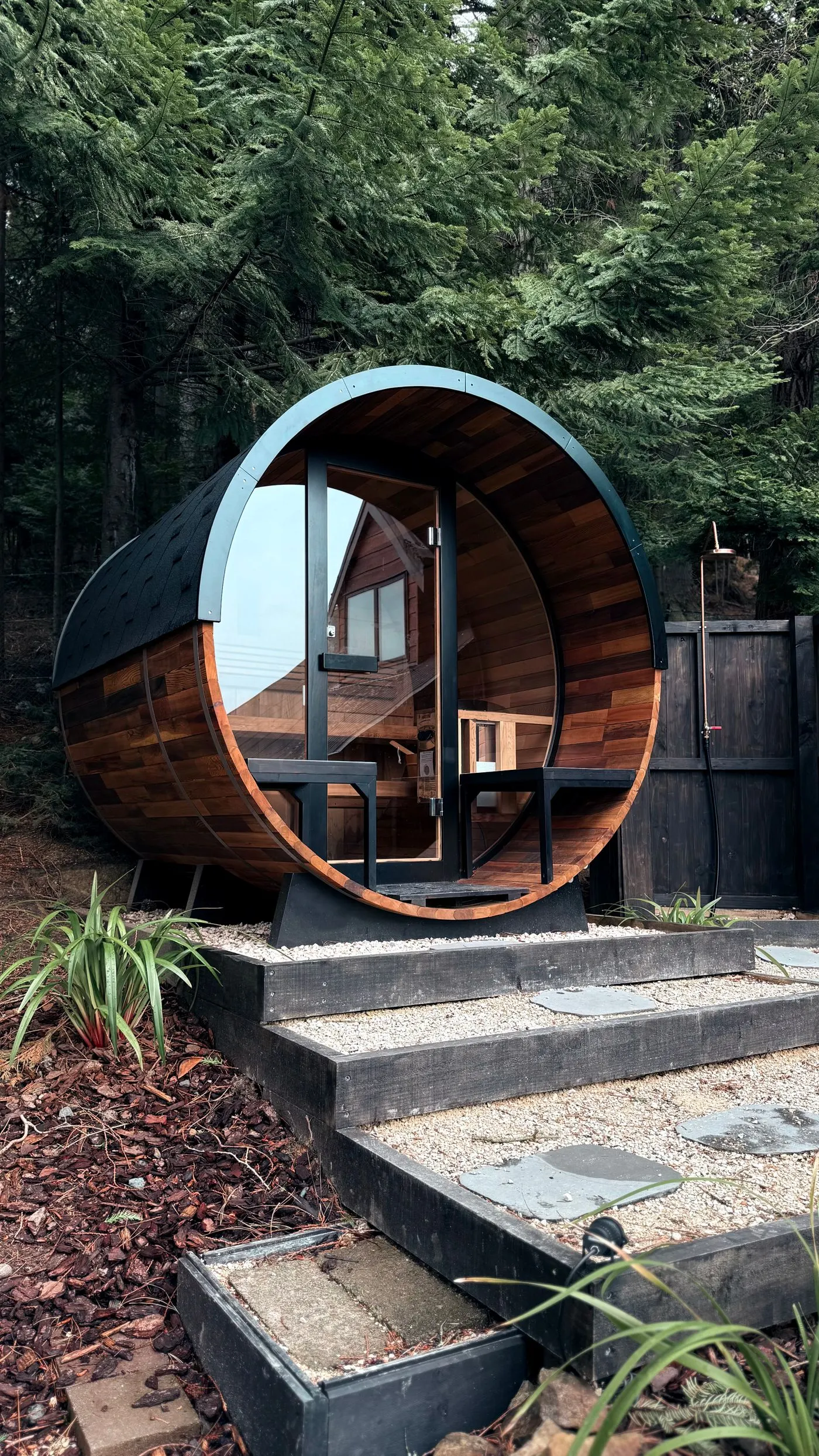
- Gravel pad: a compacted, well-draining bed — economical, simpler, handling frost by draining and moving evenly — suiting lighter saunas on reasonable ground.
How each handles frost
| Ground screws | Gravel pad | |
|---|---|---|
| Frost strategy | Depth — below the frost line | Drainage & even movement |
| Support | Strong, deep, level | Stable, drained bed |
| Difficult/sloping ground | Excellent | Best on reasonable ground |
Screws resist frost by going deep so the ground under them doesn’t freeze and lift them. A gravel pad uses drainage and even movement to reduce frost problems — built well on suitable, drained ground. Both are valid — see foundation depth and the frost line.
Sloping or difficult ground
Ground screws are generally better here — driven to different depths to reach stable support and levelled across a slope, handling ground a gravel pad would struggle with. A gravel pad suits reasonably level, workable ground. So for a slope or difficult soil, screws are often the stronger choice — see building on a slope and clay or rock.
Cost and effort
- Gravel pad — economical and generally simpler for a capable builder (excavate, add and compact drained stone).
- Ground screws — cost more and need the right equipment, often meaning specialised installation.
Compare cost against what your site and sauna need, not price alone — see outdoor sauna cost.
Adjustability
One screw-pile advantage: they can often be adjusted to level the sauna and, in many cases, correct minor movement over time — useful where ground movement is possible. A gravel pad, once built, is harder to adjust. If adjustability matters, screws have the edge.
Which to choose
| Choose ground screws for… | Choose a gravel pad for… |
|---|---|
| Difficult or sloping ground | Reasonable, workable ground |
| Deep frost resistance | Economy and simplicity |
| Adjustability and levelling | Excellent drainage |
| Heavier or demanding builds | Lighter saunas |
Compare also ground screws vs concrete piers and gravel pad vs slab for the fuller picture.
Common mistakes
- A gravel pad on difficult or sloping ground that needs screws.
- Ground screws where a simpler gravel pad would do.
- Choosing on price alone, ignoring frost and ground.
- A poorly compacted or under-drained gravel pad.
- Screws installed without the right equipment.
Next steps
Match the foundation to your ground, sauna and budget: ground screws for difficult ground, slopes, frost resistance and adjustability; a gravel pad for economy, drainage and simplicity on suitable ground. Both handle a cold-climate winter well — mind frost and drainage, and see choosing a foundation to weigh every option.
Frequently asked questions
Are ground screws or a gravel pad better for a sauna foundation?
It depends on your ground, sauna and budget. Ground screws (screw piles) go deep, often below the frost line, giving strong, level, frost-resistant, adjustable support that suits difficult, sloping or frost-prone ground, but cost more and need the right equipment. A gravel pad is an economical, well-draining, simpler bed that handles frost gently and suits lighter saunas on reasonable ground. Choose ground screws for difficult ground, slopes and frost resistance; a gravel pad for economy, drainage and simplicity. Both are proven cold-climate foundations.
How do ground screws and a gravel pad handle frost?
Ground screws resist frost by going deep, often below the frost line, so the ground under them doesn't freeze and lift them, giving stable support through winter. A gravel pad handles frost differently — its draining stone lets water pass through and it moves gently and evenly with the ground, reducing frost problems, though it must be well built on suitable, drained ground. So screws use depth and gravel uses drainage and even movement. Both are valid frost strategies; the right one depends on your ground and sauna. See our guides on frost heave and foundation depth.
Which is better for sloping or difficult ground?
Ground screws are generally better for sloping, uneven or difficult ground — they can be driven to different depths to reach stable support and levelled across a slope, handling ground that a gravel pad would struggle with. A gravel pad suits reasonably level, workable ground. So if your site slopes or has difficult soil, screw piles are often the stronger choice, while a gravel pad excels on more straightforward ground. Match the foundation to your site's conditions, and for tricky ground, ground screws' adaptability is a real advantage. See our guides on building on a slope.
Is a gravel pad cheaper than ground screws?
Generally yes — a gravel pad is economical, using compacted stone and simpler labour, while ground screws cost more and need the right installation equipment to drive them. This cost difference is a major reason gravel pads are popular for lighter saunas on suitable ground. That said, ground screws' strength, frost resistance and suitability for difficult ground can justify the extra cost where those matter. Compare cost against what your site and sauna actually need, rather than choosing on price alone. See our outdoor sauna cost guide.
Can ground screws be adjusted or levelled later?
Yes — one advantage of ground screws is that they can often be adjusted to level the sauna and, in many cases, to correct minor movement over time, which is useful in a cold climate where some ground movement is possible. A gravel pad, once built, is harder to adjust after the fact. So if adjustability and easy levelling matter to you, ground screws have an edge. Follow the product's guidance for installation and any adjustment. This adjustability, along with frost resistance, is part of what makes screw piles suited to difficult conditions.
Which foundation is easier to install, screws or gravel?
A gravel pad is generally simpler for a capable builder to construct — excavating, adding and compacting drained stone — while ground screws need the right equipment to drive the piles properly, which often means specialised installation. So a gravel pad can be more of a straightforward build, while ground screws trade simpler DIY for professional-level installation and equipment. If simplicity is a priority and your ground suits it, a gravel pad may be easier; if you need screws' strength and frost resistance, the installation is worth arranging. Match to your capabilities and site.